Paris

Cruise port guide

Paris

Paris is a river-cruise port, not a sea port: ships tie up at a Seine quay in the heart of the city, putting the Eiffel Tower, the Louvre, and Notre-Dame within a short Métro ride or riverside walk of the gangway.

Facts verified Aug 12, 2026 · cross-checked across 15 sources

Photo by Dmitrii E. on Unsplash

To the tourist area
4 kmVerified
Métro or RER from the nearest station, or a walk along the Seine
Country
France
Currency
Euro (EUR)
Language
French
Time
Paris (UTC+01) standard time
Emergency
Dial 112 in an emergency
Verified Sourced Estimate

At a glance

Before you step off

French is the working language and the euro the currency, so a contactless card covers almost everything and a little cash is handy only for a cafe counter or a market stall; a US dollar buys roughly 0.88 euro at recent rates. Power is the European Type C/E plug at 230 volts, so North American travellers need both an adapter and a device that can handle the higher voltage. The US State Department lists France at Level 2, exercise increased caution, which in central Paris mostly means watching for pickpockets on the Metro and around the big sights rather than anything dramatic.

Paris is a river-cruise port, not a sea port: your ship ties up at a quay on the Seine in the middle of the city, so you step off already downtown rather than facing a long pier transfer. The Metro and RER reach every landmark in this guide within about twenty minutes, a booklet of tickets or a day pass is the lowest-cost way around, and much of the historic core is walkable along the water. Settle a transport pass and a plug adapter before you go ashore, then keep the day loose enough to linger.

The crew’s read, written from the verified facts in this guide.

What to do

The top 10 things to do in Paris

The 10 that earn your hours first, and 5 more below them, ranked.

Eiffel Tower Must see

Photo: Benh LIEU SONG · Public domain

№ 1 of 15

Eiffel Tower

~1h 30m 0.2 km from the pier walk Lift ticket

The 300-metre iron tower is the reason most first-timers come to Paris, and it holds up close as much as it does from across the river. Book a timed lift ticket online before your day ashore or the queues will eat an hour, and go early or at dusk when the light is kindest. If heights or crowds aren't your thing, the view of it from the Trocadéro or a Seine bridge is free and just as good a photo.

Nothing planned yet

Add something from the list or the map and your day will appear here.

    What to eat

    Know the local table

    Bakeries and bistros carry the eating day in Paris. Lunch can be as simple as a filled baguette or a slice of quiche, dinner as classic as steak frites, and a patisserie stop on the walk back is close to obligatory.

    Paris food runs from the corner bakery to the white-tablecloth bistro, and the honest truth is that the plain end is often the best value. A baguette sandwich or a wedge of quiche from a boulangerie is a proper midday meal for a few euros; a classic bistro turns out a croque-monsieur and the rest of the canon without reinventing anything. Sit-down prices climb fast beside the big monuments, so eat a few streets back from the Eiffel Tower or the Louvre, and save room for macarons and eclairs on the way back to the ship.

    Jambon-beurre

    Photo: Al4az · CC BY-SA 4.0

    dish

    Jambon-beurre

    The definitive Parisian lunch: good ham and a scrape of butter inside a fresh baguette, and nothing else. Bakeries sell thousands a day, and it is the city's most-eaten sandwich.

    Gluten: Typically contains gluten; recipes vary, so askDairy: Typically contains dairy; recipes vary, so ask

    Steak frites

    Photo: LuvsMG481 · CC BY-SA 4.0

    dish

    Steak frites

    Seared steak with a heap of thin fries, the default order in any bistro. Usually served with a peppercorn or bearnaise sauce and a simple green salad.

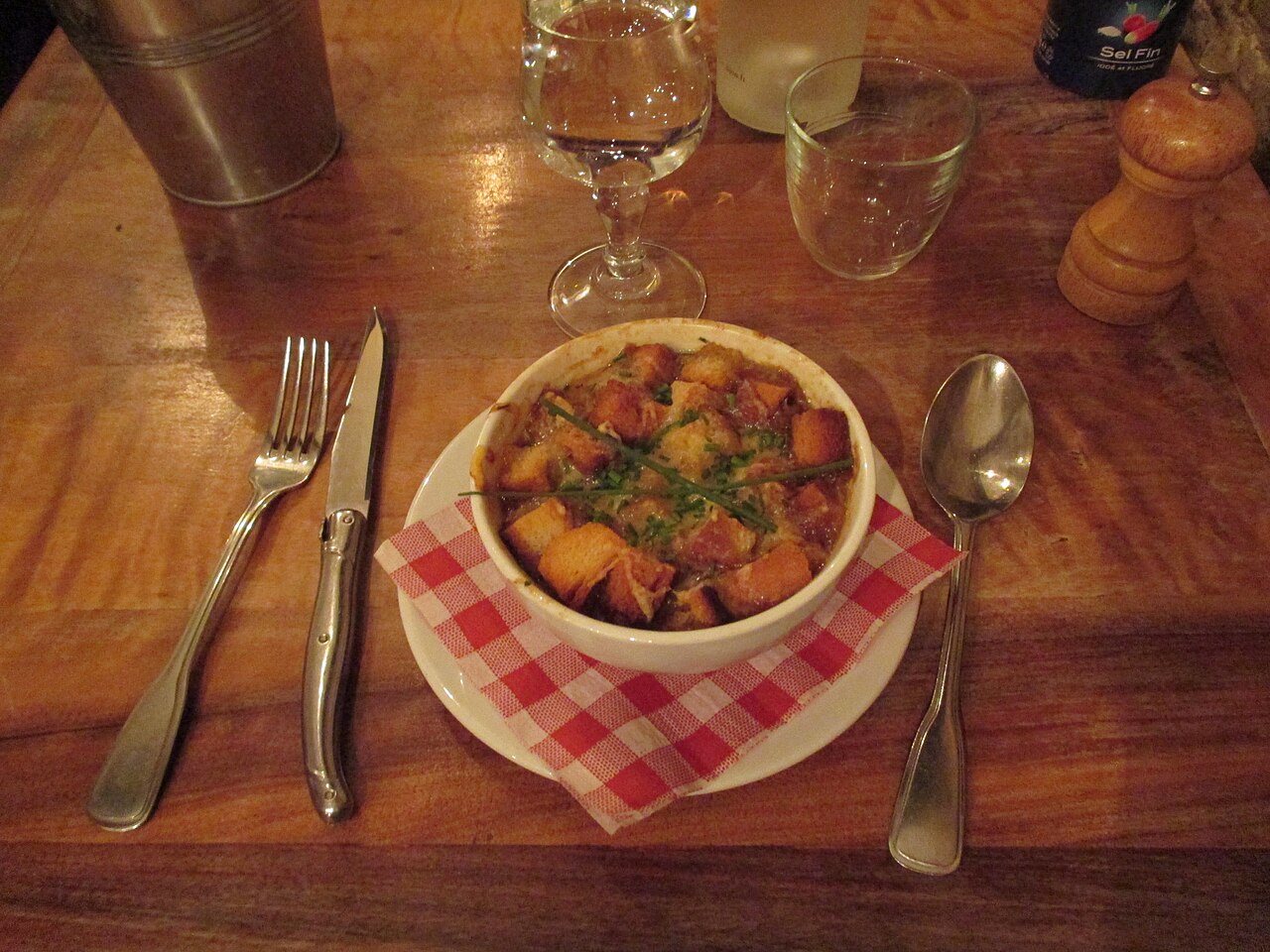
    Soupe a l'oignon

    Photo: Arnaud 25 · CC BY-SA 4.0

    dish

    Soupe a l'oignon

    Onions cooked slowly to sweetness in beef broth, topped with a raft of bread and Gruyere browned under the grill. A cold-weather classic born in the old Les Halles market.

    Gluten: Typically contains gluten; recipes vary, so askDairy: Typically contains dairy; recipes vary, so ask

    Croque-monsieur

    Photo: Ruth Hartnup · CC BY 2.0

    dish

    Croque-monsieur

    A grilled ham-and-cheese layered with bechamel and baked until the top blisters, the archetypal cafe hot sandwich. Add a fried egg and it becomes a croque-madame.

    Gluten: Typically contains gluten; recipes vary, so askDairy: Typically contains dairy; recipes vary, so ask

    Macaron

    Photo: John Mason · CC BY 2.0

    dish

    Macaron

    Two almond-meringue shells sandwiching ganache or buttercream, in every colour a patisserie window can hold. The Paris version is delicate and chewy, not the coconut macaroon.

    Egg: Typically contains egg; recipes vary, so askDairy: Typically contains dairy; recipes vary, so ask

    Allergy flags reflect the typical recipe. Kitchens vary, so always ask.

    When to sail

    When to go, month by month

    Every cell below is computed from 3,653 days of observations and 45 hurricane seasons. Color is the month's weather verdict, and each number is the measurement behind it.

    Our call: August, weighing weather everywhere, plus fares and crowds where we track sailings.

    January, written out

    January is the quiet heart of winter and the thinnest stretch of the river-cruise calendar. Afternoons top out near 44 degrees, nights drop to about 35, and rain is frequent rather than heavy at roughly 58mm, so pack a warm layer and a compact umbrella. The upside is short queues at the Louvre and the Orsay and a city that belongs to Parisians again. Jour de l'an on the 1st closes many shops and museums, so check hours if you sail over New Year, and lean on the covered galleries and cafes when the wind picks up along the Seine.

    Still firmly winter, February stays cold and grey, with highs around 47 and lows near 35 and about 54mm of rain across the month. Sailings are few, but the trade is real: the big museums are at their calmest and a warm brasserie lunch feels earned. No public holiday falls this month, so opening hours are normal. Dress for damp cold, plan the day around indoor sights with a riverside walk between them, and treat any bright spell as a bonus rather than the plan.

    March is the shoulder that opens the season, and the light starts to return even as the chill lingers. Expect highs near 52, nights around 38, and roughly 54mm of rain, so layers and a fold-away umbrella still earn their place. Gardens begin to green and terraces reappear on the first mild days. Lundi de Paques can land late in the month and shorten some hours, so check the calendar if you sail near Easter, and otherwise enjoy a city waking up before the crowds arrive.

    April is proper spring and one of the loveliest times to be ashore, with the chestnuts in blossom and cafe terraces filling up. Highs run about 58, nights near 42, and rain eases only a little to around 51mm, so showers still pass through; carry a light layer and keep plans flexible. There is no public holiday in the window this month, which keeps hours predictable. It is a fine time for the gardens, the riverbanks, and a long walk between sights before the summer rush builds.

    May is warm, green, and busy, arguably the sweet spot of the Paris season. Afternoons reach about 66, nights sit near 49, and rainfall is around 60mm in passing spring showers, so an umbrella still travels with you. The month is thick with public holidays, Fete du Travail on the 1st, Victoire 1945 on the 8th, plus Ascension and Lundi de Pentecote, and any of them can close shops and draw crowds to the parks. Plan ticketed sights around the dates, start early, and the long light evenings are yours for the riverside.

    June brings long days and reliable warmth, with highs near 71, nights around 55, and roughly 63mm of rain in occasional afternoon showers. The city stays out late, terraces are full, and the Fete de la Musique fills the streets with free concerts around the solstice. No public holiday interrupts the month, so hours are steady. It is a strong time for a full day ashore: use the light to stretch the day, keep a thin rain layer handy, and take the evening slowly along the Seine.

    July is high summer, warm and mostly bright, with highs about 76, nights near 58, and around 51mm of rain that tends to come in short storms. It is peak season, so expect queues at the marquee sights and book timed tickets ahead. Fete nationale on the 14th, Bastille Day, is the spectacle of the year: a morning military parade on the Champs-Elysees and fireworks over the Eiffel Tower at night, with many businesses closed and the centre busy. If you sail around it, plan for crowds and lean into the celebration.

    August is warm and a touch drier than July feels, with highs near 75, nights around 58, and roughly 51mm of rain. It is the month Parisians leave on holiday, so some family-run bistros and shops shut for a few weeks even as the monuments stay open and busy with visitors. Assomption on the 15th closes many businesses. Expect a slightly emptier, more relaxed city in the residential quarters and a crowded core; time the big sights early and keep the afternoon loose.

    September may be the best all-round month to be ashore: still warm at about 70 by day and 54 at night, with rainfall easing to around 44mm, the driest stretch of the year here. Summer crowds thin as the school term begins, terraces stay lively, and the light turns golden. No public holiday falls this month, so hours are normal. It is an easy month to fill with a long walk between sights, a garden hour, and a late lunch, with less need to plan around weather or queues.

    October is autumn proper, cooler and wetter, with highs near 60, nights around 47, and the year's heaviest rainfall at roughly 73mm. Bring a real jacket and an umbrella, and build the day around a mix of indoor sights and covered walks. The upside is thinning crowds, turning leaves in the gardens, and a softer light for photographs. No public holiday interrupts the month. Aim outdoor time at the drier spells and keep a museum or a long cafe lunch in reserve for when the rain sets in.

    November is late autumn sliding toward winter, with highs about 51, nights near 40, and around 56mm of rain under often grey skies. Sailings taper off, but the city is calm and the museums uncrowded. Two public holidays land this month, Toussaint on the 1st and Armistice 1918 on the 11th, and both can shorten hours and bring commemorations. Dress warm, plan around indoor sights and the covered passages, and treat a bright afternoon on the riverbank as a small gift.

    December is cold and festive, with highs near 45, nights around 36, and roughly 64mm of rain, and the occasional cold snap. River sailings are limited, but the ones that run meet a city dressed for Christmas: markets, lights along the grand avenues, and warm dining rooms. Noel on the 25th closes most shops, museums, and many restaurants, so check hours closely if you sail over the holiday. Wrap up, keep the day short and indoor-leaning, and let the lights and a hot chocolate carry the evening.

    How the score works

    The score blends weather (50%), fares (30%) and crowds (20%) from this port's daily weather record and the sailings we track. Fares use each month's median per-night rate, so one outlier sailing can't move it. Missing signals drop out and are named; thin data shows a dash, never a fake verdict; a cat-3+ hurricane history caps a month's score. Not used here: no humidity record, no sea-temperature normals.

    Months with no tracked sailings are scored on weather alone. We don’t track every line’s schedule, so ships may still call.

    Jan Rainy

    Not scored. Not enough signal for a verdict. The weather record below still applies.

    • A typical January has 18 dry days and feels like 36°.

    Bright sun
    5h
    Port calls
    See January sailings

    Verdicts: Prime = under 15% wet days (1 mm+) and feels-like 88°F or less; Rainy = 40%+ wet days; Stormy adds a cat-3+ hurricane pass on record; the rest are Shoulder.

    What a day ashore feels like

    10-yr daily record

    July runs 28% wet days; December flips to 43%. August feels like 80° once humidity counts. January is a dry 36°.

    JFMAMJJASOND40°50°60°70°80°50%100%feels likechance of rain
    All 3,653 days, one cell per day

    dry 100+ mm

    Wettest day in the record: 58 mm (2024-10-09). Record: 2015-01-01 → 2024-12-31, ERA5 reanalysis for 48.8567, 2.3510.

    Hurricane risk, storm by storm

    1 passes · NOAA tracks

    Every named storm passing within 100 nautical miles since 1980, 1 of them, and not one between November and September.

    JanFebMarAprMayJunJulAugSepOctNovDec198020022024Kirk (2024), cat 0, 53 nm

    Sunshine

    hours per day

    June is the bright season, with 12 sun-hours a day against 5 in January.

    5J6F8M10A11M12J12J11A9S7O5N5D

    Wind never makes this list here. Daily maximums average a light 13–20 km/h all year, with no tender-cancellation risk. Daylight is the swing factor here. 8h in midwinter to 16h in midsummer changes every shore day.

    What a night costs, month by month

    fare spread per night

    Typically $428 a night in March, the year’s low on the books; September runs about $643.

    Box = middle 50% of nightly balcony fares · median line · dashed mean · dots are outliers or single sailings (grey count = sailings). Per person, taxes in.

    Computed from 3,653 daily observations (2015-01-01 → 2024-12-31, nasa-power-merra2) · storm tracks: ibtracs-v04r01, 1980–2024 · wet day = 1 mm+. Averages smooth year-to-year swings, so check the day-by-day record before you book.

    Ships & sailings, who’s here, and for how much

    all upcoming, 1,899

    All 1,899 upcoming sailings we track that call at Paris. Priced sailings are placed below on the day they’re here using their lowest cabin fare, per person per night; the month-by-month matrix above covers the next 12 months.

    1899 sailings 10 cruise lines 37 ships busiest month: September, 122 calls busiest day: Sep 13, 7 ships in port typically $471 pp/night

    The departure board. Each dot is one sailing on the day it calls here; height is its per-person, per-night fare, and bigger dots are longer cruises. A falling dot is a confirmed price drop. Its tail is the size of the cut, from the old fare down to today’s. A gold ring marks a fare well below that line’s typical here. Click a dot for its details; drag across the chart to zoom to a date range, or double-click to reset.

    Fares are the lowest cabin fare we track per sailing, taxes included, and they move daily, so click through for the live price history. Counts cover the lines we track.

    Before you go

    Questions, answered

    What is there to do at Paris cruise port?
    Eiffel Tower, Louvre Museum and Avenue des Champs-Élysées top our ranked list of things to do. Each one shows the walk or ride to reach it, the cost, and how long it needs, and you can build your own day stop by stop in the planner above.
    How do I get to downtown Paris from the cruise terminal?
    The usual way in is by métro or rer from the nearest station, or a walk along the seine. The center is about 4 km from the berth.
    What money should I bring ashore?
    The local currency is the Euro (EUR). Carry a little in cash, since small vendors often don't take cards.
    What if the day runs long, or I miss the ship?
    If a tour sold by your ship runs late, the ship waits; book independently and that safety net is gone, which matters most on long outings. If you do miss it, go straight to the port agent. The name and number are on your daily program and posted at the terminal, and they coordinate catching the ship at its next call. Carry a photo of your passport ashore separate from the original, agree the fare back before you get in the taxi, and start toward the pier well before your leave-by time.
    What's the cruise ship schedule for Paris?
    The When to sail section plots every sailing we track that calls here, 1,899 through the year ahead, each one placed on the day the ship is in port and coloured by cruise line, so you can see which ships are scheduled and when. It's the published schedule from the lines we track, not a live position tracker.

    Based on 15 sources, last verified Aug 12, 2026.

    Open data: weather & climate © Open-Meteo (CC BY 4.0); maps & places © OpenFreeMap and OpenStreetMap contributors (ODbL); storm history from NOAA IBTrACS; reference from Wikidata, Wikipedia & Wikivoyage (CC BY-SA). Photos are credited individually.